THE CURRENT
ERA of particle physics is over. When scientists at CERNannounced last July that they had found the Higgs boson – which is responsible for giving all other particles their mass – they uncovered the final missing piece in the framework that accounts for the interactions of all known particles and forces, a theory known as the Standard Model.
And that's a good thing, right? Maybe not.
The prized Higgs particle, physicists assumed, would help steer them toward better theories, ones that fix the problems known to plague the Standard Model. Instead, it has thrown the field into a confusing situation.
“We’re sitting on a puzzle that is difficult to explain,” said particle physicist Maria Spiropulu of Caltech, who works on one of the LHC's main Higgs-finding experiments, CMS.
It may sound strange, but physicists were hoping, maybe even expecting, that the Higgs would not turn out to be like they predicted it would be. At the very least, scientists hoped the properties of the Higgs would be different enough from those predicted under the Standard Model that they could show researchers how to build new models. But the Higgs' mass proved stubbornly normal, almost exactly in the place the Standard Model said it would be.
To make matters worse, scientists had hoped to find evidence for other strange particles. These could have pointed in the direction of theories beyond the Standard Model, such as the current favorite supersymmetry, which posits the existence of a heavy doppelganger to all the known subatomic bits like electrons, quarks, and photons.
Instead, they were disappointed by being right. So how do we get out of this mess? More data!
Over the next few years, experimentalists will be churning out new results, which may be able to answer questions about dark matter, the properties of neutrinos, the nature of the Higgs, and perhaps what the next era of physics will look like. Here we take a look at the experiments that you should be paying attention to. These are the ones scientists are the most excited about because they might just form the next cracks in modern physics.
Image: CMS Collection/CERN

ALTAS AND CMS
The Large Hadron Collider isn’t smashing protons right now. Instead, engineers are installing upgrades to help it search at even higher energies. The machine may be closed for business until 2015 but the massive amounts of data it has already collected is still wide open. The two main Higgs-searching experiments, ATLASand CMS, could have plenty of surprises in store.
“We looked for the low-hanging fruit," said particle physicist David Miller of the University of Chicago, who works on ATLAS. "All that we found was the Higgs, and now we’re going back for the harder stuff."
What kind of other stuff might be lurking in the data? Nobody knows for sure but the collaborations will spend the next two years combing through the data they collected in 2011 and 2012, when the Higgs was found. Scientists are hoping to see hints of other, more exotic particles, such as those predicted under a theory known as supersymmetry. They will also start to understand the Higgs better.
See, scientists don’t have some sort of red bell that goes ‘ding’ every time their detector finds a Higgs boson. In fact, ATLAS and CMS can’t actually see the Higgs at all. What they look for instead are the different particles that the Higgs decays into. The easiest-to-detect channels include when the Higgs decays to things like a quark and an anti-quark or two photons. What scientists are now trying to find out is exactly what percent of the time it decays to various different particle combinations, which will help them further pin down its properties.
It’s also possible that, with careful analysis, physicists would add up the percentages for each of the different decays and notice that they haven’t quite gotten to 100. There might be just a tiny remainder, indicating that the Higgs is decaying to particles that the detectors can’t see.
“We call that invisible decay,” said particle physicist Maria Spiropulu. The reason that might be exciting is that the Higgs could be turning into something really strange, like a dark matter particle.
We know from cosmological observations that dark matter has mass and, because the Higgs gives rise to mass, it probably has to somehow interact with dark matter. So the LHC data could tell scientists just how strong the connection is between the Higgs and dark matter. If found, these invisible decays could open up a whole new world of exploration.
“It’s fashionable to call it the ‘dark matter portal’ right now,” said Spiropulu.
Image: The ATLAS endcap. Peter Ginter/CERN

NOVA AND T2K
Neutrinos are oddballs in the Standard Model. They are tiny, nearly mass less, and barely like interacting with any other members of the subatomic zoo. Historically, they have been the subject of many surprising results and the future will probably reveal them to be even stranger. Physicists are currently trying to figure out some of their properties, which remain open questions.
“A very nice feature of these open questions is we know they all have answers that are accessible in the next round of experiments,” said physicist Maury Goodman of Argonne National Laboratory.
The U.S.-based NOvA experiment will hopefully pin down some neutrino characteristics, in particular their masses. There are three types of neutrinos: electron, muon, and tau. We know that they have a very tiny mass – at least 10 billion times smaller than an electron – but we don’t know exactly what it is nor which of the three different types is heaviest or lightest.
NOvA will attempt to figure out this mass hierarchy by shooting a beam of neutrinos from Fermi lab near Chicago 810 kilometers away to a detector in Ash River, Minnesota. A similar experiment in Japan called T2K is also sending neutrinos across 295 kilometers. As they pass through the Earth, neutrinos oscillate between their three different types. By comparing how the neutrinos look when they are first shot out versus how they appear at the distant detector, NOvA and T2K will be able to determine their properties with high precision.
T2K has been running for a couple years while NOvA is expected to begin taking data in 2014 and will run six years. Scientists hope that they will help answer some of the last remaining questions about neutrinos.
Image: The NOvA detector. Fermi lab

DARK MATTER DIRECT DETECTION
Just what is dark matter? Scientists as yet have no idea. Some say it’s a huge mass of particles affecting the shape of galaxies and clusters. Other, more unusual thinkers suggest it is an illusion arising from us misunderstanding gravity or a potentially vast dark sector of the universe waiting to be discovered.
One way or another, physicists might have some answers soon. Right now, unfortunately, all they have are problems.
There are plenty of experiments searching for direct evidence of dark matter. The difficulty is that they’re all pointing to different things. One contingent of physicists have turned on their detectors and seen absolutely nothing, indicating that they need to build even bigger and more sensitive detectors. But another group have used small and sensitive detectors to see hints of what may be dark matter. They claim the first group has simply failed to notice these subtle traces.
A very sensitive detector named LUX, which recently released the results from its first run, was supposed to help clear the confusion in the field. Instead it has added more mysteries. It seems that for the next few years, the various experiments will continue taking data and hopefully come to some sort of conclusion.
But the forces of darkness could stymie some efforts in the U.S. The effects of sequestration mean that the Department of Energy is looking to slim down the number of American dark matter experiments. In the coming months, the agency will likely fund only two or three major detection groups, said physicist Juan Collarfrom the University of Chicago.

GERDA AND MAJORANA
Despite its many successes, the Standard Model is broken. Scientists know this in part because neutrinos have mass, but the Standard Model says they shouldn’t. So it’s possible that neutrinos will lead them to further violations of the Model.
A particular type of experiment, known as neutrino-less double beta decay, could help explain something that the Standard Model struggles with: Why is the universe made of matter? More specifically, the Standard Model predicts that during the Big Bang, matter and antimatter should have been created in equal proportion. But because these two negating forms of matter destroy one another, the universe should be full of nothing. If you go and look outside the window, you’ll notice that it is actually full of many things.
Beta decay happens when a neutron (the neutral particle in an atomic nucleus) spontaneously transforms itself into a proton and an electron, emitting an antineutrino in the process. The process can also take a slightly different path, with a neutron sucking up a neutrino and turning into a proton and electron. Neutrino-less double beta decay would be an extremely rare situation where the antineutrino produced in the first event gets taken up by the neutron in the second.
Such a thing could only happen if neutrinos and antineutrinos are basically the same: That is, if the neutrino is its own antiparticle. No one yet knows if that’s true but, if it is, then in the early universe neutrino decays would have produced slightly more matter particles than antimatter. Several experiments aim to find out if neutrinos are their own antiparticles.
Currently running is the GERmanium Detector Array (GERDA) experiment, which released its first results in September. GERDA saw nothing but helped put stringent limits on the possibility of neutrino-less double beta decay. A U.S. collaboration known as MAJORANA and a Canadian experiment called SNO+ are also in the works to help figure out the details of this process. Within the next decade, they should hopefully have an answer.
Image: Scientists assemble the MAJORANA experiment. Matt Kapust/Sanford

STRANGE NEUTRINOS
Even as they search for known properties of neutrinos, such as their mass, scientists are running into new problems.
“People believe that neutrinos are more complex than the picture we think about right now,” said physicist Maury Goodman.
One of the most recent examples of this is the neutrino reactor anomaly. Neutrinos were first discovered streaming out of nuclear reactors. But a more careful analysis in 2011 suggested that for a long time scientists had been missing out on detecting a small fraction of these neutrinos. Now, experiments are needed to see if this is true. Trouble is, you need to put a detector extremely close to a nuclear reactor. A few brave experiments – CeLAND in Japan and SOX in Europe – could help researchers start to crack this problem.
This finding might be exciting because it could point to a potentially new type of neutrino, known as a sterile neutrino. Unlike the regular barely-there neutrino, which interacts through two of the four known forces (gravity and the weak force), a sterile neutrino would only make its presence known to other particles via gravity. Considering that gravity is the weakest force and neutrinos have barely any mass, actually detecting a sterile neutrino would be an arduous task.
Several other neutrino anomalies have cropped up in the last decade. An experiment called MiniBooNE, which was supposed to close the case on a previous controversial finding, has turned up several strange findings that couldpotentially lead to new properties for neutrinos. MiniBooNE is still running and will continue to probe interesting phenomena.
Image: The walls of the MiniBooNE detector. (Fermi National Accelerator Laboratory)

ICE CUBE
With its thousand sensors spread over a cubic kilometer of frozen Antarctic ice, the IceCube Neutrino Telescope is one of the craziest observatories scientists have ever devised. The probe is a real telescope, looking for neutrinos streaming in from outside our solar system and galaxy.
IceCube was completed in 2010 and released its first results last year. While the observatory was meant to help researchers answer questions about the deep universe, its findings have been somewhat perplexing. At its size, the telescope should have seen many neutrinos streaming in from the cosmos. Instead it found two. The events were so rare, the collaboration named them Bert and Ernie. This year, one more high-energy neutrino was found and named Big Bird.
Such high-energy neutrinos are thought to form in insanely powerful celestial events, like mysterious gamma-ray bursts. But IceCube failed to see any of the elusive particles at the same time that astronomers at other observatories were detecting gamma-ray bursts.
“We’ve spent some time sitting around over beers and so far I have heard no good model [that explains the findings],” said physicist John Learned of the University of Hawaii. “That’s actually the kind of situation we love. It means we’ve really got a wrong assumption somewhere.”
IceCube will continue taking data and perhaps helping to explain its own findings. But what its results show is the need for even larger neutrino telescopes (and probably more beer). Scientists have proposed the ARIANNA observatory, which would cover nearly 1,000 cubic kilometers on the Ross Ice Shelf in Antarctica and detect even higher energy neutrinos.
Image: An IceCube detector being lowered into the ice. IceCube Collaboration/NSF

LONG-BASELINE NEUTRINO EXPERIMENT
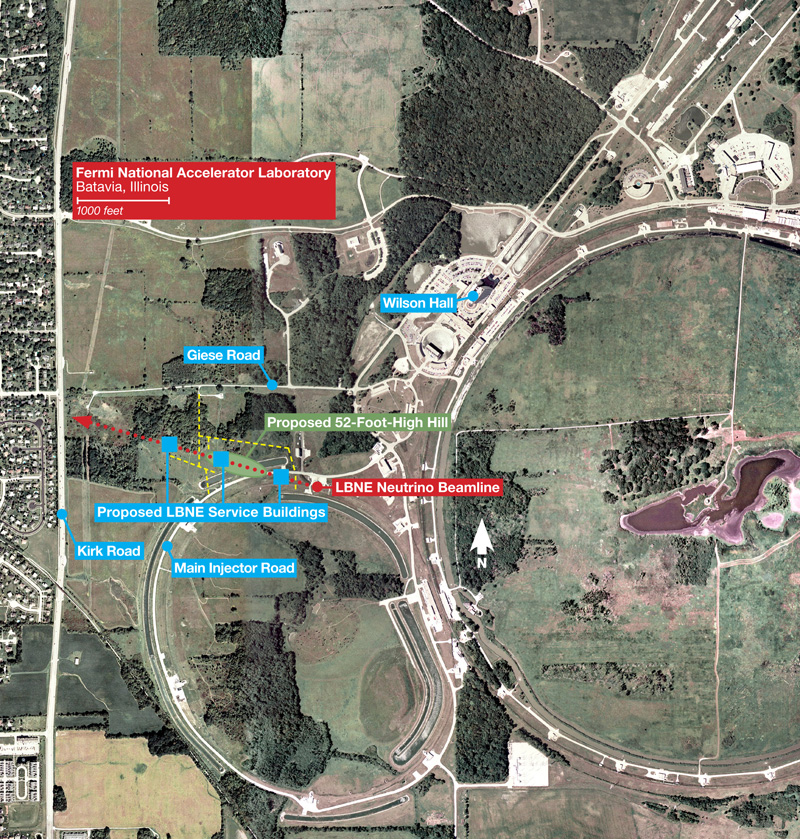
In order to really clear up all the remaining questions about neutrinos as well as any new ones that come up in the future, physicists in the U.S. hope to complete the Long-Baseline Neutrino Experiment (LBNE). This facility, located in a mine in South Dakota, would detect neutrinos shot from a beam at Fermilab in Illinois nearly 1,300 kilometers away.
By watching as they oscillate between three different types, LBNE would be a neutrino-property-discovering machine. Need to know the neutrino masses? LBNE has got your back. What’s going on with sterile neutrinos? Maybe LBNE can help. Unfortunately, the project is estimated to cost $1.5 billion. With the U.S. struggling to fund science, the Department of Energy has asked physicists to go back to the drawing board and come up with a cheaper alternative.
But many in the field are hopeful that the funding situation could brighten in a few years. Perhaps in the next decade, something like the LBNE could be built and help figure out many problems while likely encountering many exciting new mysteries to explore.
Image: Fermilab

HL-LHC AND ILC
The LHC may have only recently found its most important quarry, the Higgs, but scientists are already thinking of how to squeeze even more impressive results from the machine. If all goes according to plan, by 2020 the facility will be getting a major boost.
The High Luminosity LHC (HL-LHC) will vastly increase the energy that protons are colliding at, possibly up to 30 TeV, which is more than three times the current energy peak and just shy of the ultra-powerful Superconducting Supercollider, a U.S. project that was partially built before being canceled in the mid-90s. Engineers will also stuff the machine’s beams with more protons, yielding even more collisions and greater numbers of particles streaming out.
“The conditions will be challenging for taking data,” said particle physicist Maria Spiropulu of Caltech. “We call this the pileup.”
In particular, physicists will have to learn how to better comb through noise to see the extremely rare events that might be produced in high-energy collisions. They will spend the next few years learning what these events might look like.
“We will also have upgraded detectors – superCMS and superATLAS,” said Spiropulu. “We’ve never done anything like that before.”
Also on the drawing board are plans for the International Linear Collider (ILC), the machine that would outperform the LHC. Japan has made a strong bid to host the machine, ponying up half of its construction costs, and would like to place it in the Kitami mountain range. But the ILC’s partners, who also include Europe and the U.S., have yet to set aside the requisite funding needed for the project, which is expected to run to nearly $7 billion.
The ILC could produce huge numbers of Higgs bosons, allowing scientists to precisely probe its properties. It might also uncover other anomalous events, which could test many exotic theories beyond the Standard Model. Assuming that final designs are approved and funded (and this is far from certain), the ILC could start construction in 2016 and be completed 10 years later.
Image: Simulations of particle events at the ILC. Norman Graf

DARK ENERGY SURVEYS
One of the most unexpected discoveries at the end of the 20th century was dark energy. The idea that the universe is expanding – the space between stars and galaxies is slowly increasing – was weird, but scientists had long ago come to terms with it. Yet careful observations of distant supernova showed that the space between everything wasn’t just expanding, it was accelerating in its expansion.
Physicists still have no real clue what's causing the acceleration. Dark energy is just a stand-in term for what appears to be a very large cosmic puzzle. But several upcoming experiments will at least try to figure out what is going on.
Most will attempt this by precisely mapping thousands of galaxies and supernova in the night sky. The Dark Energy Survey (DES), which began this year, will obtain images of 300 million galaxies and 100,000 galaxy clusters. Because of the travel time of light, those that it sees farther away are also farther back in time. By figuring out how large-scale structures have changed over time, cosmologists will have a better idea of how dark energy has been working throughout history. TheHobby-Eberly Telescope Dark Energy Experiment (HETDEX) is also working to figure out how dark energy has evolved over time by observing very distant galaxies in the early universe.
Image: Dark Energy Survey Collaboration
source:http://www.wired.com/2013/11/future-physics-experiments/
Sivar A.Baiz Hawler@kurdistan 8-9-2015